
Finding a clothing manufacturer for your clothing brand is one of the biggest steps between having the clothing idea and turning it into a real product.
For new clothing or streetwear brands, the process can feel overwhelming. You end up comparing factories, figuring out MOQs, discussing fabrics , asking for samples, checking costs, and confirming they can build what you drew.
The good news is that you do not need to contact hundreds of factories blindly.
A better approach is to define your requirements first, create a shortlist of relevant manufacturers, compare them using the same criteria, and test the relationship with samples before placing a larger order.
This guide explains how to find a clothing manufacturer, where to search, what to ask, how to compare manufacturers, and how to choose a manufacturing region.
A manufacturer does more than make your garments. How they handle communication, how their production runs, their rules for quality, their minimum order amount, and quality standard will affect your final product.
The right fit depends on your specific needs.A streetwear producing limited collections may need a different manufacturing setup from an established brand placing larger repeat orders.
That is why the goal is not simply to find a clothing manufacturer. You need to find one that can realistically work with your product, quantity, quality expectations, and production requirements.
Start with your product specifications, then search for manufacturers that match those requirements. After you have a short list, ask for pricing, get clear answers to specific questions, compare responses, and order samples before committing to production.
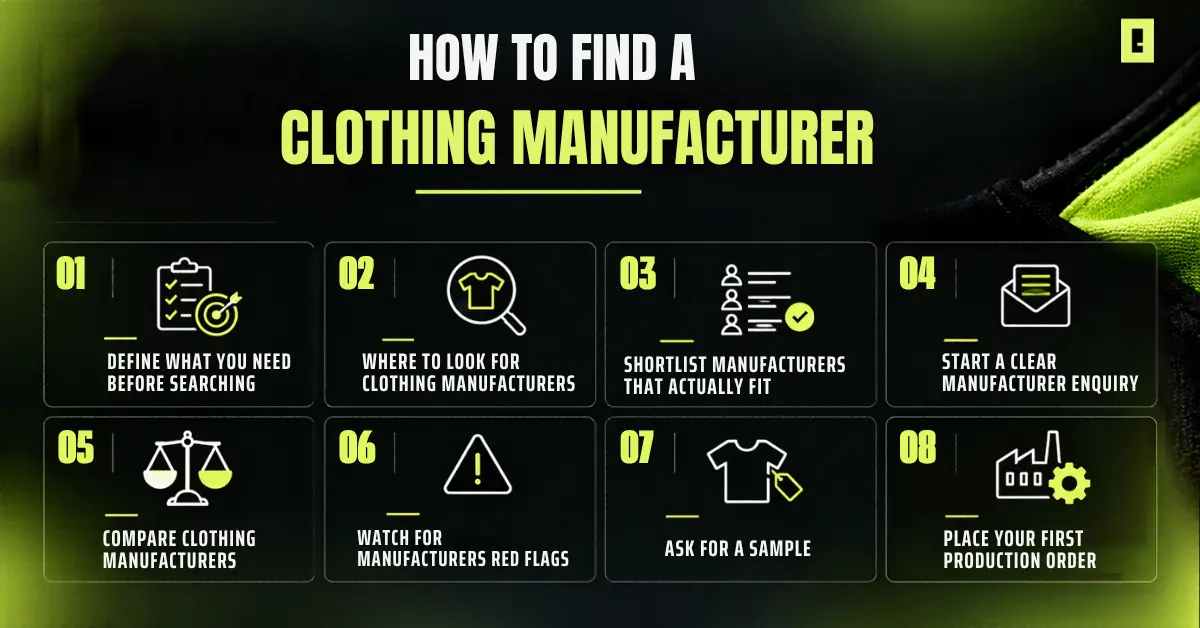
Before searching for a clothing manufacturer, get clear on what you want to produce.
| Requirement | What to determine |
| Product | T-shirt, hoodie, jeans, jacket, tracksuit, etc. |
| Fabric | Fiber, weight/GSM, finish, stretch, and other requirements. |
| Quantity | Estimated first-order quantity and future volume |
| Quality | Construction, fit, finishing, and quality expectations |
| Design | Artwork, colors, trims, labels, and placement |
| Budget | Target production cost and overall development budget |
The clearer your requirements are, the easier it is to find makers that match what you need.
If you plan on custom production, make a tech pack first. Do this before you reach out to manufacturers.
A tech pack can list things like: technical drawings, key measurements, fabric choices, how the garment is built, trims, where artwork goes, color options, and other build notes.
With that in hand, the manufacturer has a solid reference. They do not have to guess from rough sketches, quick chats, or assumptions.
If you need help preparing one, see How to Make a Tech Pack for Your Clothing Brand.
Once your requirements are clear, start building your manufacturer list.
Manufacturer directories can help you discover factories based on location, product type, capabilities, or production requirements.
If you sell to the U.S., The Department of Commerce’s Made in USA Sourcing & Products Directory is one official starting point for finding textile and apparel suppliers.
Google can be surprisingly useful when you search specifically for what you need.
Instead of searching only for “clothing manufacturer,” try terms such as:
Adding your product type or preferred location can make the results much more relevant.
Trade shows can give you the opportunity to speak directly with manufacturers, examine fabrics and samples, and understand what a factory specializes in.
They can be particularly useful if you want to develop longer-term supplier relationships.
Ask designers, brand owners, fashion professionals, and other people in your network about manufacturers they have worked with.
A referral does not automatically mean a manufacturer is suitable for your brand, but it can give you a useful starting point for your research.
Do not just message every factory you can find. First, remove manufacturers that clearly do not match your requirements.
Look at:
Start by sending enquiries to each manufacturer on your shortlist. Use the same core details for every contact.
For the first message, include the basics:
Also ask these items:
Price should not be the only thing you compare.
A manufacturer with a lower quote may not be the better fit if their MOQ, sample process, communication, or production capabilities do not match your requirements.
This can happen when the MOQ, sample work, or production limits do not line up with what you need.
Try to look at the completed picture:
Be cautious with a manufacturer if you notice these issues.
One strange reply by itself does not always mean the manufacturer is not trustworthy.
Do not go straight from the design file to a big production run. If you can, create a sample first.
A sample gives you the real garment to judge. You are not stuck with only pictures or written descriptions.
Check these items:
If you notice any issue, write it down. Then ask for a new sample or a revision when it makes sense.
Sampling also shows you how the manufacturer handles your notes. This helps you decide if you are ready for bulk production.
Place your first production order with care. After you pick a manufacturer and sign off on the sample, do not rush the last step.
Before production starts, double check every item on your list. Include these details in the final version:
Also, keep all final specifications and approvals organized so there is a clear record of what was agreed.
There is no single manufacturing country that works for every clothing brand.
Your choice should depend on the type of garment, order quantity, target cost, quality requirements, location of your customers, shipping considerations, and the individual manufacturer’s capabilities.
| Region | What to consider |
| Portugal | Often considered by brands looking for European production and premium apparel development. |
| Italy | Commonly associated with fashion manufacturing and premium/luxury production; costs and factory requirements vary. |
| Turkey | Its location can be useful for brands considering European and nearby markets, with a broad textile and apparel industry. |
| Romania & Poland | European options worth researching for brands that want production closer to European markets. |
| China | Large and diverse manufacturing ecosystem with many apparel production capabilities; factory selection is critical. |
| Vietnam | A significant apparel manufacturing market, particularly worth researching for brands looking at established production facilities. |
| USA | Can be relevant for brands prioritizing domestic production or proximity to the U.S. market, depending on product and budget. |
These are starting points, not guarantees of quality, pricing, or MOQ. Conditions can differ significantly between individual factories within the same country.
Start by asking a few simple questions.
If your buyers are mostly in one area, choose a production spot that is nearer to that market. This can change shipping time and make handling easier.
Your expected volume can determine which manufacturers are willing to work with you.
Some manufacturers specialize in particular garment types, fabrics, construction methods, or quality levels
Do not only look at the unit price. Compare the full total cost so you can see what you will actually pay.
A basic garment and a heavily constructed streetwear piece may require very different manufacturing capabilities.
You might also see CMT (Cut, Make, Trim) and full-package manufacturing.
With a CMT, the manufacturer generally focuses on cutting, sewing, and finishing the garments while the brand may need to arrange materials and other production inputs.
The brand often has to arrange fabric and other items needed for production. Full-package manufacturing usually covers more steps.
That can include finding materials and overseeing parts of the garment development process.
The exact services included can vary between manufacturers, so always ask what is included in the quoted price.
A vague enquiry usually produces vague answers. Give manufacturers enough information to understand what you actually want
Always check MOQ before spending time on detailed discussions. A factory may be excellent but unsuitable if its minimum order is far beyond your planned quantity.
Requesting a sample helps you spot issues early. This can stop small defects from turning into a full production problem.
Use the same core specifications when requesting quotes. This makes your comparisons much more meaningful.
Finding a clothing manufacturer becomes much easier when you treat it as a structured sourcing process rather than a simple Google search.
Start with a clear product brief and tech pack that shows materials, sizes, and key details. This keeps back and forth low.
Then make a small list of possible factories. Contact them with the same questions each time. Ask about lead times, fabric options, and past work that matches your style. Compare answers side by side, not just the cost.
After that, ask for samples. Review fit, stitching, and finish in the way your brand needs. Only then decide on bulk production.
Most importantly, choose a manufacturer based on how well their capabilities and production process match your specific clothing brand, not simply on where they are located or how low their initial quote looks.
Start by defining your product, quantity, materials, quality requirements, and budget. Then search directories, Google, trade shows, referrals, and industry networks to build a shortlist of manufacturers that match your requirements.
Ask about MOQ, pricing, sample costs, production timelines, fabric sourcing, customization, payment terms, shipping, labels, packaging, and quality control. Also confirm exactly what is included in the quoted price.
For custom clothing production, a detailed tech pack can help communicate measurements, materials, construction, artwork, and other production specifications clearly. It gives the manufacturer a shared reference during sampling and production.
MOQ means Minimum Order Quantity. It is the smallest quantity a manufacturer requires you to order, and it can vary by manufacturer, garment, fabric, color, and production requirements.
Yes, when sample development is available, reviewing a sample before bulk production lets you check fit, fabric, construction, artwork, measurements, and finishing. It also gives you an opportunity to request changes before committing to a larger order.
Consider your product type, order quantity, target cost, quality requirements, customer location, shipping, and the manufacturer’s specific capabilities. The best location depends on your project rather than simply choosing a country based on its reputation for apparel production.